new filmkritik

Dienstag, 30.10.2007

Free Suhrkamp/William Raban

Wenn das Buch zum Film so debil ist wie der Film, hat dieses Verlagsprogramm künftig einen lokalisierbaren Tiefpunkt. Lange nicht mehr so armseliges deutsches Kino gesehen. Wie sich Weingartners bestenfalls unausgegorenes Kritikverständnis mit dramaturgischer Unfähigkeit, schäbigen Typisierungen und peinlichen Fassbinderumarmungsgesten mischt, ist fast nicht mehr beschreibbar. Zu den erfreulichen Entdeckungen des vergangenen Viennale-Wochenendes zählt Thames Film von William Raban. Ein Flussfilm, der ökonomie- und kulturhistorische Perspektiven ineinanderwebt; mit einer dichten Soundtextur, aus der immer wieder die Stimme T.S. Eliots auftaucht und Passagen der „Four Quartets“ rezitiert:

I do not know much about gods; but I think that the river
Is a strong brown god – sullen, untamed and intractable,
Patient to some degree, at first recognised as a frontier;
Useful, untrustworthy, as a conveyor of commerce;
The only a problem confronting the builder of bridges.
The problem once solved, the brown god is almost forgotten
By the dwellers in cities – ever, however, implacable.
Keeping his seasons, and rages, destroyer, reminder
Of what men choose to forget. Unhonoured, unpropitiated
By worshippers of the machine, but waiting, watching and waiting.
His rhythm was present in the nursery bedroom,
In the rank ailanthus of the April dooryard,
In the smell of grapes on the autumn table,
And the evening circle in the winter gaslight.

Samstag, 27.10.2007

Hoch lebe Lelouch

Jean Douchets Spruch, Claude Lelouch liebe zwar fraglos das Kino, dieses aber erwidere die Geste nicht, ist DAS unübertreffliche Fehlurteil in der Geschichte der Filmkritik. Die weit verbreitete Sitte, den erfolgreichsten (und jüngsten) Regisseur der Nouvelle Vague gering zu schätzen, verstärkt freilich nur noch die Freuden seiner Bewunderer. Denn die sagen höchst vergnügt: Das kann doch nicht sein, man muss des verrückten Rennfahrers experimentelle Blockbuster doch lieben.
Vielleicht trotzdem nicht überflüssig: der Hinweis auf mindestens zwei an diesem Wochenende offene Einstiege in die Lelouchliebhaberei.

Eine Katze jagt die Maus / LE CHAT ET LA SOURIS (1975), mit Michèle Morgan und Serge Reggiani. Im BR um 0:15 in der Nacht von Samstag auf Sonntag
und
Begegnung in Venedig / HASARDS OU COINCIDENCES (1998), mit Alessandra Martines und Pierre Arditi. In der ARD um 0:00 in der Nacht von Sonntag auf Montag

Donnerstag, 25.10.2007

John Ford: The Man and His Films

Das Standardwerk zu John Ford, 1986 erschienen. Jetzt hat Tag Gallagher es überarbeitet. „Tag estimates it is roughly 40% new material, large and small changes, and all the frame enlargements are new. The latter detail is saying quite a lot considering Gallagher is an artist with still frames and their placement.“ (Andy Rector, Kino Slang).
Das Buch als pdf-Datei: http://rapidshare.com/files/61830908/ford_tag3.pdf.zip [19MB].

Montag, 22.10.2007

Zeitschriftenhinweise

Soeben erschienen: Shomingeki Nr. 19

Erinnerungen an Kei Kumai (Rüdiger Tomczak)
Verteidigung der Zeit von Peter Nestler (Johannes Beringer)
Nicht versöhnt von Jean-Marie Straub (Stefan Flach)
Anstelle eines Nachrufs für Herbert Linder (Stefan Flach)
Hommage für Kiyoshi Atsumi (Claude R. Blouin)
Eine Nachlese zur Retrospektive Mikio Naruse (Barbara Wurm)
O Sangue (Das Blut) von Pedro Costa (Johannes Beringer)
Juventude em marcha (Jugend voran) von Pedro Costa (Johannes Beringer)
Weiße Serie (I) (Bettina Klix)
Erinnerungen an Indien (Rüdiger Tomczak)
Mansur mian-r ghora (The last Ride) (Rüdiger Tomczak)
Nishijapan (After the Night…Dawn) von Sandip Ray (Pradip Biswas)
Notizen zu einigen Filmbüchern von Pradip Biswas (Rüdiger Tomczak)
Notizen zu einigen Filmen der Berlinale 2007 (Rüdiger Tomczak)
State Legislature von Frederick Wiseman (Johannes Beringer)
Nachmittag von Angela Schanelec (Johannes Beringer)
Dann nehme ich eben alles (Schwarze Serie I) (Bettina Klix)
Inland Empire von David Lynch (Bettina Klix)
Beim Erwerb eines Buches – zu Helmut Färbers Buch Soshun (Julia Bantzer)

*

Soeben erschienen: SigiGötz Enterntainment, Die zwölfte Fügung

SigiGötz Entertainment fordert: Ehrenpreis der deutschen Filmakademie für Siggi Götz
Der andere Pornorama
SigiGötz Entertainment präsentiert: Der Kanon des Deutschen Films, 101 deutschsprachige Tonfilme ausgewählt und kommentiert von Stefan Ertl, Rainer Knepperges und Ulrich Mannes. Unterstützt von Olaf Möller und Hans Schifferle.
SigiGötz Entertainment Centerfold
Eine in sich geschlossene Kinogeschichte
Incognito Ergo Sum (Sepp Knarrengeier)
Und was tut sich bei den SUPERNASEN-FANS?
Gehört, gelesen, zitiert

Sonntag, 21.10.2007

BOARDING – Ein Gespräch mit Apichatpong Weerasethakul

Nicolas Wackerbarth: As president of the jury, you had to watch all films of the FID, the Festival International du Documentaire. Did you find any time to see anything of Marseille? It’s a great city.

Apichatpong Weerasethakul: I had a chance to walk around a bit this morning, but I prefer to travel around in Asia. It’s more interesting. Europe is very boring. The architecture is very similar. When you look at the details of course not, but in general, you know, it is too democratic, I think. You see more suffering in Asia, more interesting people you can talk to.

Sure, but don’t you have more cultural life here?

It depends, what you call culture.

Well, you go to a cafe, you discuss a film with friends, you go to a museum or a concert.

That doesn’t exist there. But you have more time to think about yourself It’s a different idea of living.

So maybe we could do an interview now, what do you think?

Now? It’s not much time till we reach the airport.

I’ll just tape our conversation. Is it okay with you?

Sure…

I haven’t prepared anyhting right now, but I have seen all your films. I ´ve read in the festival journal of FID that you have also written a novel, is that correct?

I want to, but I haven’t. I just wrote articles.

So, maybe we could also print an essay of yours, if you want.

Ok, do you pay?

No.

Ok. (laughs)

That’s a principle of our magazine.

To write a novel it will take a long time, because my main focus is movies and installations. But I know it won’t last, because the money is hard to find. One dream is writing a book. You know, that could be… after I’ve failed with finding money or whatever.

In our last issue, Ulrich Köhler, a German filmmaker who is also a great admirer of your work, said he would really prefer to be a writer if he would have the skills for it or enough talent.

It is a different media. I have to learn a totally new craft. It’s not like writing a script.

How do you write a script?

I just write as I see it in my head and from the dialogue that I gather.
And it’s very different from a novel in terms of structure. That’s why my movies cannot be written, afterwards, you know. They just can’t be written.

I was curious when I heard you are interested in writing a novel, because your film are so cinematic. You really have to see them to understand them.

The script is just a map, it’s not the finished film. Hitchcock said: When you finished the script, the film is finished. But for me it’s the opposite. The script is just a playground to have something happening there. It’s so flexible.

Still your films seem very conceptual. Similar to Hitchcock.

But Hitchcock is very narrative.

Still I think not every director has a clear idea… of style. Of course Hitchcock worked with genre, crime stories, but as a director he knew exactly what he wants to tell beyond that. He has a concept and stays with it.

Hichcock is a master of tricks. I like his films, but he is a master of his own time. We have to find a way for the new kind of cinema. You know, Hitchcock is dead. (laughs) I admire him, but it is not my generation. When you look at a Minnelli film, it is also a super film. Those films are super, narrative-wise, structure-wise and also regarding the conceptual things… But we obviously have moved to another level of conceptual films than regular Hollywood. And Hollywood is becoming worse, like a decay of narrative.

So you have the feeling that narration is in a crisis?

Yes. But for me I try to overlook that and I just try to work on my own way. It’s not like a quest for a new form, it’s just a quest not to attach to all those narratives. I am trying to challenge my own feelings to a film, that’s more honest. If you try to break a taboo or to find a new structure, I think, the work will become pretty hard and cold.

I was asking myself why your films work. They are so free, but they are still held together. The answer could be: Because everything I see is very personal.

Well, it works for me, it works for you, maybe it works for someone else too, but in different ways. I have my own code in a film. You can look at the film and you have your own code, too. And Thai people have their own interpretation as well. That’s something that can’t be translated in subtitles. It doesn’t mean that it makes it less approachable for other foreigners.

There is such a softness, everything seems to be very gentle and the actors are… there is a certain open minded atmosphere around them.

Because that’s the film I want to see. I liked to see many Hollywood films, I still enjoy it, but I can’t make those films myself.

But also compared to other artistically ambitious films from Europe or like Bresson for example… You don’t have any judgement in your films, you don’t separate, you bring certain things together that are often regarded as inappeasable.

I think that the problem is that people try too much to become academic. The culture of film criticism is very corrupt. I think it corrupted cinema. Because if you analyse, it loses something…. I mean for the filmmaker who cares so much about criticism. For me everyone has their own conservative way. For me my conservativsm is just to do a film for myself and to make sure that I can express my own feelings to this film. That’s my rule. But for someone like Bresson… he trapped himself by having so many rules. I found it very conservative, you know… But that’s his own problem, for me it’s not. So everyone has their own rules and sometimes…

So again, what exactly is your orientation in your work?

My feelings, my feelings…

But filming is so stressfull, there is the camera, the lights have to be set… you have to organise everything…

Definitely, but I try. You see, normally we have fourty shooting days and if I will go over fourty, I will be in trouble because of the budget, for example. I have to be really alert on the set. I´ll have to be aware that everthing what is happening is really mine… but there are certain days when I have to cancel the shooting, because I can’t connect. It happens rarely, but it happens.

I think we have to get out of the car right now… Which gate is yours?

Let me see…14… I’ll check in, look there is no one! Lufthansa is very fast.
If I go to a festival I always want to choose my airline.

I fly with Air France, they are very bureaucratic.

Yes, you are right, very slow. Wait, I want to look for a present for my boyfriend.

They have this Marseille soap. It’s nice,

I’ve heard about it. This olive soap. Great.

But that’s a lot, isn’t it?

No, no, it’s also for all my staff, my company. Maybe we could sit here till my boarding begins.

Of course, so… How is a day of shooting at your set?

It’s very intense. We don’t have a lot of days and I like to have many takes and everything is conflicting with one another… We don’t have much film material,
not much equipment, everything is not really comfortable. It’s like a normal movie, but it’s more intense, because we work in a small group.

Do you always work with the same director of photography?

No, but I wish. You know, sometimes our schedules just don’t allow it and he has to take another job. But in the last film, „Syndromes And A Century“, I worked with Sayombhu Mukdeeprom, my prefered director of photography.

I was curious how a film with your style will look when you are going to shoot inside a building. All your other films like „Blissfully Yours“, „Tropical Malady“ have been located mainly in nature.

I think it’s the same, it’s just a matter of… I just say what I want… know what I want to say and check with a photo.

But you have the different flucations of time in nature that complements a minimalism like for example in „Blissfull Yours“ more easily. I was curious how you will succeed.

It’s more instinctive. In this hospital I find my own corners that I like, and I went there many times before the shooting with my director of photography. We discuss a lot, also with my assistant… It’s not only about me… We have this intense moment together. It’s important for all to have that same understanding by going there before. But during the shooting I didn’t know whether I will succeed.

How many takes do you usually need?

As many as the films allow. I always shoot more than two, the maximum was thirty, which is very rarely.

Why?

Sometimes it’s a long take, and there are little things that are not right. It really depends so much on the feeling. Everything is feeling! That’s why it is really important to work with the same crew, because they no longer question why something has to be done again, because they know that it won’t work. Why? Because they know right away. My assistant looks at me and she sees that it is not gonna work.

You have these people in natural surroundings and we come close to a feeling of real time, but in „Syndromes“ we have a construction of parallels, time gaps, reflections, little stories.

„Tropical Maladay“ or „Blissfully Yours“ are both quite linear, they focus on real time, it’s true. But for „Syndromes“ we threw that away and wanted to do it more fragmented. We only focused on the situation or which rooms we like, for example the hall way. That’s why in the later part of „Syndromes“, in the ending, you only see these rooms and corridors. It becomes something nonlinear. And that’s when I introduce soundtrack, which I’ve never done before. Because it’s not reality, it’s not my usual reality. The time is not the usual time. When there is this jumbo of time, it becomes something like unconnected memories and feelings of loss in space. I would say the air is what you hear and that is shifted as well. So that’s what we tried to do with the soundtrack, to create a shifted ambience.

But the film is so pure and in the end you use such a tool, I wasn’t sure about it…. It seemed to me a bit manipulative, a bit threatening, like there is another power somewhere which dominates me.

That’s cinema. It is about manipulation. Even when you are in the jungle like in Tropical Malady certain birds which you may call normal sound from nature are just sound design. Only that the audience doesn’t know it. You know, everything is artificial.

But there you use just little tricks to fill up some parts of the film, in „Syndromes“ you made a clear decision: ‚Now I use soundtrack.‘

This soundtrack is just another step… not a step up or down, but a step I want to convey… That’s about the sensitivity, because I wanted the audience to feel this. If I usually hear soundtrack I don’t like it, because it traps the audiences, it forces the audiences to feel scared or to feel happy. So I used something else and I tried to find a very mutual sound. At least for me that frequency is linked to my feeling. (laughs) It’s not music, it’s a sound.

I thought you wanted to emphasize your criticism of this new big hospital where everyone is totally lost.

No, no. But it’s okay. If you feel that way, because I don’t do the film for you, I do the film for me. When I do something it is really important to think of my sensitivity.

So you never think about your audience?

Never! Never! (laughs) I only think about myself as an audience.
It sounds ignorant, but it’s true. And that’s why I told you that I want to write a book later, when nobody funds my films and they don’t care about my shit anymore… It will be okay. I always prepare. That’s how I operate.

Where do you take this kind of strength, what’s your orientation?

You mean experience?

Maybe…

I think that’s life. I am really interested in buddhism. Illusion is nothing… everything always changes. You know, when I won a price in Cannes, I called my mum and she said: ‚Well, rememeber this, it’s not gonna last.‘ So what do I work for? I visited Ray Bradbury. He is an American science fiction writer I really admire. He is an old man in a little room in LA, but before he was really famous… you see? So I say: Just leave the moment and do whatever you want. What the hell with other people i don’t care. (laughs)

Maybe we will see a science fiction movie of yours one day.

I am planning.

When I saw your new short film „Anthem“ here at FID Marseille, I thought that it was an utopia, but one which is happening right now, in the present.

That’s the title of my next film.

Oh, I didn’t know.

Mabye you have a good instinct while we are talking to each other. The next two films are twin films. One is called „Primitive“ and the other one is called „Utopia“.

I am not into Buddhism at all. I am from a European Country and, in a way, I see your films very naive. You connect things which I regard as being divided or working against each other. Old and new… religion and aerobic, pop music and ghosts…You really try to find something new.

I am trying to, but it’s difficult, because there are so many traps. You know the formula of science fiction films with all this memory stuff, like for example „Solaris“. Many deal with the human psyche. It’s always about how you define consciousness in the future… but this is a trap, it’s a cliché. For me I don’t want to make an invention, I don’t want to break rules. But in order to make a film, I have to feel strongly specific emotions about the future. That’s my wall which I have to break through.

So you talked about the traps, what you don’t want to do. But what do you want to do?

To see a film that I like. A film that has a sense of history, but that is not talking about history. It’s a sense of looking ahead, a sense of possibility. We are moving and moving towards the future. I don’t know how far at least. This is always linked with history and time. You know, in Buddhism they teach that time is divided into many layers and there is one layer that has a different concept of time. To simplify things, if you say one sentence in that world, it could mean a century in this time. That interests me. But that’s history. I want to talk about time in the sense that scientists do, like Einstein, who also was trying to crack that subject. (laughs) So I try to express that into moving images.

It’s very theoretical.

Yes!

But do you believe in that personally? I can comprehend these layers in a way. While we are talking, different thoughts are parallel in my head: my boyfriend is waiting for me at Gate 21 B – I’ll have to do the check in in a few minutes – I have to find my passport. There are different times around us. But it is on a higher, total abstract level… can you really understand that emotionally? Do you believe in it personally?

I do, I do. But then again, will you call this science fiction? Is that documentary? Is that queer cinema? I don’t know.

These genres are not interesting, not any more.

I think, more and more people care less, more filmmaker give a shit about it.

Talking about time, I think we have to take a look at …

Oh, God, I’ve got my boarding in five minutes.
Langtexthinweis

* Nicolas Wackerbarth, der unter anderem bei Revolver mitmacht, trifft Apichatpong Weerasethakul im Juli 2007 in Marseille auf dem Weg zum Flughafen und unterhält sich mit ihm. Die Transkription dieses Gesprächs findet sich jetzt auf der Langtextseite: BOARDING – Ein Gespräch mit Apichatpong Weerasethakul.

ANTHEM von Apichatpong Weerasethakul und HALBE STUNDEN von Nicolas Wackerbarth sind auf der seit Donnerstag laufenden Viennale in Wien zu sehen.

Donnerstag, 18.10.2007

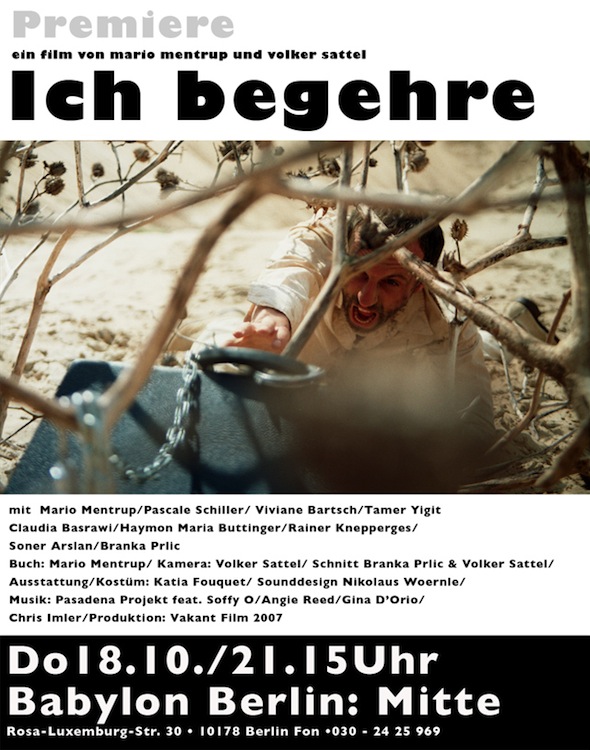
ich_begehre

Von schöner Unordnung

trst_01

Im Katalog des 6. I mille occhi (Trst, 22.-29.9.’07) charakterisierte dessen Großer Aushecker, Sergio Grmek Germani, eines der Meisterwerke des Festivals wie überhaupt des Jahres 2007, Giulio Questis VISITORS (2006), als einen ‚Film von absoluter Unaktualität, der bestens demonstriert, wie man Partei ergreifen und zugleich frei sein kann — wider alle revisionistischen Anmaßungen‘. Was auch dieses in seinem Entwurf gigantische, allein von seiner Gestalt her kleine Festival bestens beschreibt: völlig desinteressiert am jeweils letzten Schrei einer kontemporären Filmkultur von beunruhigend kleingeistiger Krämerseeligkeit, Produkt jenes – immer rasenderen – aber stopbaren! – Fortschritts ohne Entwicklung, vor dem Pasolini immer warnte, an dem Pavese erlosch, gegen den Huillet & Straub arbeite(te)n…

I mille occhi, das ist – der Traum vom – Neorealismus, konkret rossellinisch wie als anwendbare Utopie: Kino als Kommunikation, beständiges Forschen, pragmatisch aufklärerisch, vor allem neugierig, darin verspielt wie widerspruchslustig, nahezu ferronisch, ergo stets gewillt, Ideen neu zu bedenken, immer komplexer zu definieren. Man könnte und sollte hier auch von der permanenten Revolution sprechen – Du bist nur die Gegenwart!: ward je rossellinischeres gesagt? -, ob der Art, wie sich das Festival von Durchgang zu Durchgang aus dem vorherigen neu erfindet, idiosynkratisch wie luzide. Ganz so wie Jacques Baratier, seine Filme — ein paar Appetithappen nur ’07, zwei kurze, zwei lange, doch schon die machen sichtbar, wie besessen er sich beständig neu schöpft… nächstes Jahr mehr; und dann endlich auch die vier Fassungen von Mario Bavas unvollendeten CANI ARRABIATI (1974): vier praktische Phantasien über einen auteur… Bava, wiederum, wurde dieses Jahr mit dem kürzlich verstorbenen Avantgarde-Meister Alberto Grifi kurzgeschlossen, durch die Väter, die beide Erfinder waren — und überhaupt: habe ich nicht schon wiederholt gesagt, daß Alberto Grifi & Gianfranco Baruchellos LE VERIFICA INCERTA (DISPERSE EXCLAMATORY PHASE) (1964/65) der perfekte Vorfilm wäre zu Mario Bavas TERRORE NELLO SPAZIO (1965)?, die könnten ja sogar ihre Titel tauschen.

Anders als in früheren Jahren gab’s diesen Durchgang kein dominantes Ganzes, keine Werkschau(en) als Planet(en) mit Film-Monde drumrum. Stattdessen: kleinteilige Poesie komplexer Kontraste höchster Steilheit, Fortschreibungen früherer Programme – z.B. Werner Schröter – werden zu Vorankündigungen kommender Attraktionen – J. Lee Thompsons YIELD TO THE NIGHT (1956), präsentiert a prospos DEUX (2004), in dem Isabelle Huppert die Fabel dieses monströs bewegenden Melodrams recht verdreht erzählt bekommt, verheißt das Glück einer für 2008 annoncierten Seth Holt-Retrospektive -, Preis in all dem des Fragments, Lob der geistigen Bewegungen zwischen den Dingen, des Unterschwelligen, Subversiven, Transgressiven. Wer sein Festival eröffnet mit der Uraufführung einer seinerzeit unterdrückten Kurzdokumentation von Carl Theodor Dreyer, VANDET PAA LANDET (1946), gefolgt von Huillet & Straubs letztem Brandkanon, EUROPE 2005 – 27 OCTOBRE (2006), gefolgt von Werner Schröters frühen, weitestgehend Maria Calles gewidmeten Normal-8-Exerzitien, abgerundet durch drei weitere, kurze erzieherische Maßnahmen Dreyers, der kennt keine Furcht: der weiß wohl, einfach und befreiend, um die Wirkung des klar empfundenen Sehens und Hörens, und auch darum, daß es keine Nebenwerke gibt, nur Filme. Zur Klärung der Verhältnisse, als Linie im Sand folgte später noch Shinkichi Tajiri & Ole Eges demütig-zärtlicher BODIL JOENSEN ‚A SUMMERDAY‘ JULY 1970 (1970): ein Dänenmann für die Jünger der Kanonischen Korrektheit — zack!, Kino als Kunst der Beunruhigung, Erkenntniszittern ob der irrlichternde Harmonien zwischen Dreyers – von seinen Auftraggebern als defätistische Nestbeschmutzung empfundene – Aufklärungsarbeit über die Vergiftung von Brunnenwasser durch rurale Schlampertheit und Tajiri & Eges Portrait eines zoophilen Pornostars gesehen als Godiva der Verlorenen… FEROCE.

Ähnlich schallerte es zur Nacht des Märtyrer-der-afrikanischen-Befreiung-Tages dank – der englischsprachigen Exportfassung von – Gualtiero Giacopetti & Franco Prosperis AFRICA ADDIO (1966), denn: das meistdiskutierte aller Mondo-Werke mag ja in seiner ganzen todesgeilen Desinvoltura erzfaschistisch sein, bringt – dabei – aber allerhand ganz konkret und korrekt auf den Punkt. Ziemlich verstörend, jetzt, ist u.a. das Ruanda-Segment: ein Völkermord, der in den 90ern vielen angeblich unbekannt war, kommt in einem der erfolgreichsten, durchpolemisiertesten Filme der 60er Jahre zur Sprache, wobei Jacopetti & Prosperi an Analyse und Hintergründen ziemlich exakt, wenn auch bloß skizzenhaft das liefern, was man 30 Jahre später – immer noch – zu hören bekam… 41 Jahre ist das jetzt alles her.

Für entsprechend Bewegte, Engagierte mag es ein Affront gewesen sein, AFRICA ADDIO nach u.a. Flora Gomes‘ wundersamen Musical NHA FALA (2002), Gaston Kabores Instantklassiker ZAN BOKO (1988), und Raoul Pecks kontemplativer Recherche LUMUMBA: LA MORT D’UN PROPHETE (1992) zu zeigen — im Kontext des Festivals, jedoch, seines rossellinischen Geistes, war es vor allem: konsequent. Denn: die Mondo-Filme stellten genau jene Glaubwürdigkeit des Bildes, jene Wahrhaftigkeit des Wirklichen implizit in Frage, auf der die Idee des Neorealismus basiert, auch dadurch, daß sie sich auf die Kamera als Wahrnehmer der Realität beriefen, also auf eine realistische Tradition, neorealistische Tropen, Konzepte, Phrasen; im Raum hingen, so, wieder einmal, die faschistischen Wurzeln, die der Neorealismus auch hat. Will der Neorealismus politisch wirksam sein, muß er sich aktiv mit seinem eigenen Widerspruchspotential auseinandersetzen, sonst droht Gefahr. (Die sieht dann vielleicht so aus wie die kürzlich veröffentlichte dvd-Edition von „La rabbia“, 1963: die Pasolini-Hälfte ist der Film, die Guareschi-Hälfte ein Bonus…)

Gleich genial war’s, Rick Salomons 1 NIGHT IN PARIS (2004) aus der Sphäre des Heimischen – Internet, dvd – zu reißen und in einem Kino zu projezieren: so eine Banalität des Banalsten zu thematisieren, politisieren — das Kino als moralische Anstalt, durch den unfaßbar durchschnittlichen Sex zweier Menschen, die nur noch Darsteller eines – kann man überhaupt noch sagen: ihres? – Daseins sind, quasi Modelle, Bresson pervers.

Einer der unheimlichsten Reime des I mille occhi-Programms: Hilton, wie in Paris, aber auch in Mary, der von Pin-Up-Ikone Diana Dors verkörperten Todeskindidatin aus YIELD TO THE NIGHT; der auch „Eine zum Tode verurteilte kann nicht entfliehen, oder Der Wind weht wie er will“ hätte heißen können, oder, schlicht, „Kein Loch“ — die reverenziell paraphrasierten Filme von Bresson und Becker waren auch zu sehen, letzterer in einer extrem seltenen italienischen 16mm-Fassung, ersterer als Miszelle zu ersterem, von dvd im Nebensaal; Dors, dann, ähnelt in dem Film, speziell in den Rückblenden, ganz verblüffend Maria Callas — The Basis of Make-Up: Zeitgeist.

Womit man wieder beim Eröffnungsabend wäre. VANDAT PAA LANDET wurde – bislang – bloß digital – restauriert? rekonstruiert? – zugänglich gemacht, eine Einstellung fehlt auch noch, was durch eine entsprechende Schrifttafel platzhalternd vermerkt wird; die Normal-8-Werke Schröters wurden von digiBeta projeziert, was ihnen auf der großen Leinwand des Teatro Miela eine Sichtbarkeit, Gegenwart verlieh, die sie von ihrem Originalformat aus bloß im kleinsten Rahmen haben (in Oberhausen, vor einigen Jahren, konnte man sie noch einmal so sehen); BODIL JOENSEN ‚A SUMMERDAY‘ JULY 1970, schließlich, war der einzige Film des allein aus dvds bzw. Videos bestehenden Programmsegments Tabu (v.o. fuori formato), in dem der Idee des Verbotenen im Kino nachgegangen wurde — nun gut, eine weitere Ausnahme gab’s: der Überraschungsfilm, MAESTRO Nando Ciceros rabiat theoretisches Debüt. LO SCIPPO (1966) lief unter Einsatz der angeblich einzigen noch existierenden Kopie (danke, Sergio!).

Mit einem mal ging’s dann um Alles: wie sich die Verhältnisse verschieben, wenn das Private und das Öffentliche, das Vage und das Konkrete, das mehr und das weniger Sanktionierte die Räume tauschen, wenn die Materialien keine Wertsicherheiten mehr bieten – was spätestens dann der Fall ist, wenn Murnau & Flaherty, Bresson, und de Oliveira von dvd laufen, Lee Thompson, Tajiri & Ege, und Cicero aber als Film – oder? -, wenn plötzlich Arbeiten in einem öffentlichen Raum zu sehen sind, die man aus Rechtsgründen nicht zeigen darf und die doch X Leute auf Video bzw. dvd bzw. im Computer haben, dank gewisser Beziehungen – eines dieser Werke tauchte in einem anderen, völlig ‚legalen‘ Film unkreditiert auf, als Delirium -, wenn also alle Werte durch gezielte Vertauschungen in Frage gestellt werden, wenn Surrealismus zur materialistischen Dialektik wird. Das mag man vielleicht alles wissen, aber wo zeigt es sich in unserer Filmkultur ja? Und wenn es sich nie so zeigt, wissen’s denn auch wirklich alle – wichtiger noch: kümmert’s wen? Sind’s die eigenen Angelegenheiten?

Das alles im Gedenken an den Filmsammler und Altcinephil Piero Tortolina, der u.a. Giacomo Gentilomos exquisites, halblanges Debut ECCO LA RADIO! (1940) rettete.

trst_02

– Olaf Möller –

Langtexthinweis

* Olaf Möller war in Trst auf dem Filmfestival I mille occhi (22.-29.9.07) und berichtet davon auf der Langtextseite – Von schöner Unordnung.

Mittwoch, 17.10.2007

Hinweise, Peter Nestler in Berlin

Von Montag, 22.10., bis Donnerstag, 25.10., werden in der DFFB im Rahmen eines Seminars von Jörg Becker Filme von Peter Nestler gezeigt. Alle Interessierten sind herzlich dazu eingeladen. Programm und Anmeldung bei Frau Gräwe: graewe@dffb.de

Am 27.10. ist Nestlers neuer Film, VERTEIDIGUNG DER ZEIT, im Arsenal zu sehen. Anschließend gibt es ein Gespräch mit dem Regisseur, geführt von Jörg Becker und Carlos Bustamante.


atasehir escort atasehir escort kadikoy escort kartal escort bostanci escort